Our Blog

Bracketology

December 7th, 2023

Analyzing strong points, looking for potential problems, making comparisons—it’s bracketology time! Nope, not basketball (although we hear they have something similar), but a brief analysis of your orthodontic options when it comes to choosing a winning bracket.

If you’re getting braces, you’re probably already familiar with how they work—brackets are bonded to the teeth to hold an archwire, which provides gentle, controlled pressure to move the teeth into alignment. But within that basic bracket-and-wire system, there are several different bracket designs available to you at our McCook, North Platte, or Ogallala orthodontic office. Let’s see what the scouting report has turned up on our final four, pointing out their distinct advantages as well as some potential mismatches.

Traditional metal brackets

Advantages:

  • Traditional braces with metal brackets are effective for more than just straightening teeth. They can be used to correct rotated teeth, differences in tooth height, and bite problems. For severe bite and alignment problems, traditional braces are most often the right choice.
  • Metal construction makes these brackets able to handle the controlled pressure needed to treat serious malocclusions.
  • Cost-effective. These are usually the least expensive option.

Potential Disadvantage:

Clear/Ceramic Brackets

Advantages:

  • Lack of visibility! Whether you go for clear brackets or brackets tinted to match your enamel, you’ll be keeping a low-profile with this choice.
  • Stronger and more stain-resistant than ever before, using the latest in ceramic, porcelain, or plastic materials.

Potential Disadvantages:

  • Not as durable. Unlike metal, these clear brackets can crack or break. If you play a contact sport, these might not be for you.
  • Some ceramic brackets are larger than other choices, so might be recommended only for the top teeth.
  • Clear or tinted brackets can be more expensive.

Self-Ligating Brackets

Advantages:

  • These brackets use a clip or trapdoor mechanism to hold your archwire without the need of bands. Ceramic options are available if you want an even more discreet appearance.
  • Can be more comfortable with less friction between wire and bracket.

Potential Disadvantages:

  • Self-ligating braces are generally more expensive.

Lingual Braces

Advantages:

  • Lingual braces use metal brackets, but they attach to the back of each tooth for almost invisible bite correction.
  • Custom-made. Lingual brackets can be designed and fabricated to fit your individual teeth perfectly.

Potential Disadvantages:

  • Trickier to clean because of their placement behind teeth.
  • Might not be suitable for a deep bite if there’s not enough clearance between top and bottom teeth.
  • Initial discomfort caused by the tongue’s contact with the braces when you speak and eat.
  • Custom-made brackets are more expensive.

So that’s a brief rundown of your bracket choices. But, unlike sports bracketology, there are no losers here! Dr. Bradley Hoppens and Dr. Mary Beth Meier can give you the pros and cons of each bracket design, so you can make an informed decision based on the kind of braces which will work best for you. With coaching like that, no matter which bracket option you choose, the final result is the same—a winning smile!


Shark Teeth

November 30th, 2023

It seems like sharks are everywhere these days—on land, sea, and air(waves). A halftime show meme gone viral. A week of summer TV devoted to our favorite apex predators. And who doesn’t have “Baby Shark” playing in their heads all day once they’ve heard it? But are we jumping the shark to discuss this topic in an orthodontic blog?

Not at all! Because today, we’re going to talk about shark teeth—just not the ones you might be expecting.

One of the expected sights when a shark opens its mouth are those rows and rows of shiny shark teeth. Sharks can grow from two to 15 rows of teeth at any one time (and some sharks have even more). This means sharp new teeth are always ready to replace any shark tooth which is lost, broken, or worn out.

An unexpected sight? When children point to their new adult tooth or teeth coming in—right behind their still-firmly rooted baby teeth! This double set of teeth is called “shark teeth,” and, while it certainly might come as a surprise, it’s not all that uncommon. But why do children develop shark teeth at all?

After all, baby, or primary, teeth have small roots, and are designed to come out easily when the adult teeth start arriving. When a permanent tooth starts to erupt, it pushes against the root of the baby tooth above it. This pressure gradually dissolves the root of the primary tooth, and with nothing to anchor it, it’s now loose, wiggly, and ready to fall out. That’s why baby teeth often look like they have no roots at all when they eventually wiggle free.

Sometimes, though, the roots of a primary tooth don’t break down, which means baby teeth stay right where they are. It also means that the permanent teeth have to erupt somewhere else—usually behind those stubborn little baby teeth.

Shark teeth can first appear around the ages of five to seven when the permanent front teeth start arriving, or several years later, when the adult molars begin to come in. Any extra teeth in one small jaw naturally raise concerns about tooth misalignment, especially when those extra teeth are molars. If double molars are causing crowding, it’s a good time for your child to have an orthodontic examination at our McCook, North Platte, or Ogallala office to make sure the permanent teeth are properly positioned.

Unlike sharks, we don’t have an endless supply of replacement teeth, so it’s understandable to worry when you see anything unexpected. If you want to know more about shark teeth, or if you have any concerns, don’t hesitate to call Dr. Bradley Hoppens and Dr. Mary Beth Meier for expert advice.

Thanksgiving in North America

November 22nd, 2023

Thanksgiving marks the start to the holidays; a season filled with feasting, indulging, and spending time with family and friends are always special. Thanksgiving is a holiday meant for giving thanks, and while this may seem like such a natural celebration, the United States is only one of a handful of countries to officially celebrate with a holiday.

Unlike many holidays, Thanksgiving is a secular holiday, and it is celebrated on the fourth Thursday in November in the United States. In Canada, it is celebrated on the second Monday of October, which is, oddly enough, much closer to a time when harvests were likely gathered. In addition to the different dates, the origins of the celebration also share different roots.

Thanksgiving in the United States

Giving thanks for a bountiful harvest are not new, but the modern day holiday in the US can be traced to a celebration at Plymouth in Massachusetts in 1621. This feast of thanksgiving was inspired by a good harvest, and the tradition was simply continued on. At first, the colony at Plymouth didn't have enough food to feed everyone present, but the Native Americans helped by providing seeds and teaching them how to fish, and they soon began to be able to hold a feast worthy of the name. The tradition spread, and by the 1660s, most of New England was hosting a Thanksgiving feast in honor of the harvest.

Canadian Thanksgiving

An explorer of early Canada named Martin Frobisher is accredited for the first Canadian Thanksgiving. He survived the arduous journey from England through harsh weather conditions and rough terrain, and after his last voyage from Europe to present-day Nunavut, he held a formal ceremony to give thanks for his survival and good fortune. As time passed and more settlers arrived, a feast was added to what quickly became a yearly tradition. Another explorer, Samuel de Champlain, is linked to the first actual Thanksgiving celebration in honor of a successful harvest; settlers who arrived with him in New France celebrated the harvest with a bountiful feast.

A Modern Thanksgiving

Today, Thanksgiving is traditionally celebrated with the best of Americana. From feasts and football games to getting ready for the start of the Christmas shopping season, Thanksgiving means roasted turkey, pumpkin pie, and green bean casserole. No matter how you celebrate this momentous day, pause for a moment to give thanks for your friends, family, and all the bounties you’ve received. Happy Thanksgiving from Hoppens & Meier Orthodontics!

Common Issues with Braces: How to avoid bad breath

November 15th, 2023

A bright, beautiful smile is often achieved with braces. The time you spend wearing braces is an investment in the good health and appearance of your smile. However, Dr. Bradley Hoppens and Dr. Mary Beth Meier and our staff know that having braces on your teeth can pose challenges. Many of these challenges are commonly faced by all who wear braces, such as flossing, getting food stuck in your braces, and bad breath.

Today, let’s address bad breath and what to do about it. There’s no reason you have to shy away from conversation for fear that you’ve got bad breath.

Fresh Breath Tips for Braces Wearers

  • Eat a Healthy Diet. Unhealthy foods that are laden with sugar can contribute to bad breath. Stick with healthy produce, protein, grains, and dairy found on the list of foods your orthodontist says are safe to eat with braces.
  • Drink Non-Sugary Beverages. Likewise, steer clear of sugary sodas and juices for the same reason. They contribute to bad breath.
  • Stay Hydrated. A mouth that’s continually dry can lead to bad breath by inhibiting your production of saliva. Regular production of saliva removes bacteria and excess food from your mouth, both of which cause bad breath.
  • Brush Often. Brush your teeth and tongue first thing in the morning, after each meal and snack, and before you go to bed, to remove food particles and bacteria that cause bad breath.
  • Don’t Forget to Floss. Flossing with braces might seem tricky, but it is a necessity. Ask Dr. Bradley Hoppens and Dr. Mary Beth Meier to show you the best way to floss effectively with braces.
  • Mouthwash Use. Use the mouthwash recommended by Dr. Bradley Hoppens and Dr. Mary Beth Meier. For the best results, swish the mouthwash around in your mouth for 30 seconds.
  • Get Regular Cleanings. Regular dental exams and cleanings are more important when you have braces. Cavities can delay your treatment progress, so be sure to visit your dentist every six months.

Practice Good Hygiene Daily

Good oral hygiene practices are important every day, whether you wear braces or not. But they become even more important during the months you wear braces. In addition to your regular orthodontic checkups, see your general dentist for cleanings and exams.

Together, you and our McCook, North Platte, or Ogallala team will keep your mouth healthy and fresh during and after your orthodontic treatment.

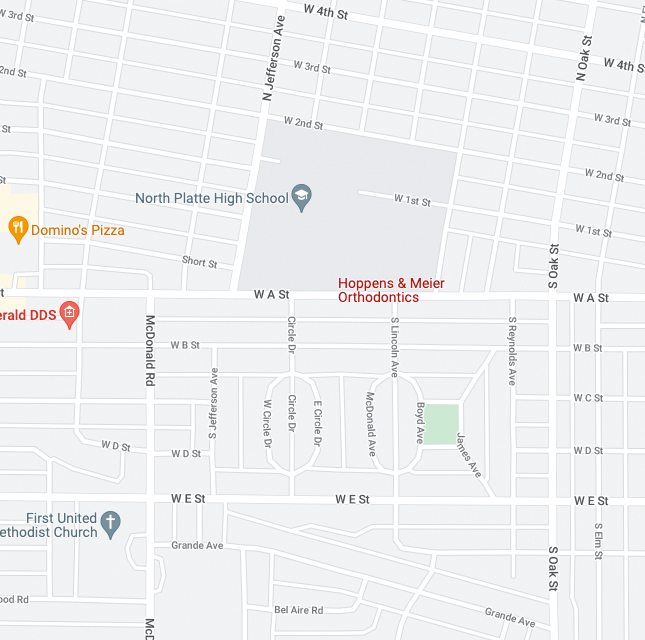
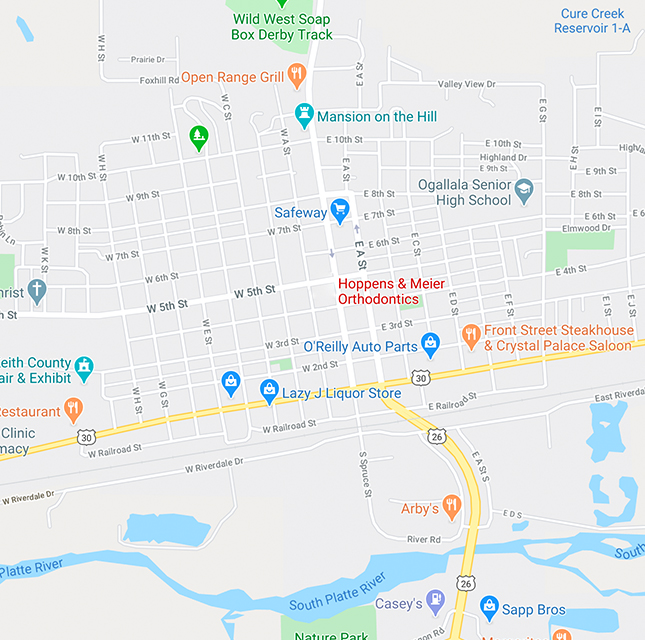
Our main offices and satellite locations

Contact Us!